
By Dulce Brown
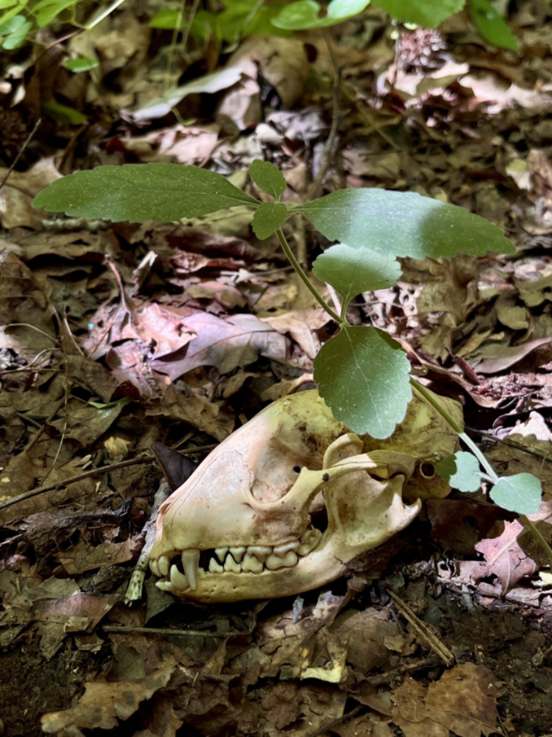
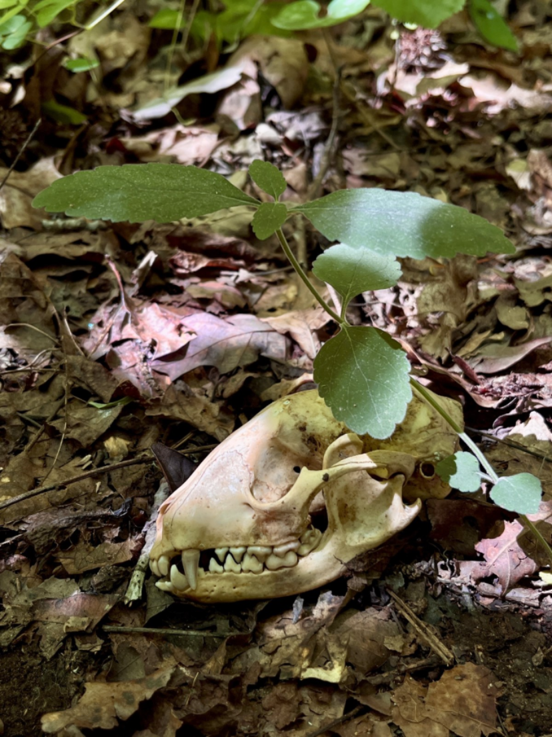
While surveying for Scutellaria montana, we stumbled upon an incredible photo set up: a raccoon skull posed directly under a skullcap! Photo credit: Austin Young.
When hiking though the Tennessee River Gorge most people notice the towering oaks and hickories, or perhaps a conspicuous singing warbler or tanager. A little lower to the ground, however, lives a less obvious resident... the large- flowered skullcap (Scutellaria montana), hereafter referred to as large-flowered skullcap. As you may guess from its name, skullcaps have a distinctive flower. It has a vase-like base diverging into a head-like upper lip that is hinged to a lower lip flaring out below. Flowers range in color from purple to white and give a shape reminiscent of a snapdragon.
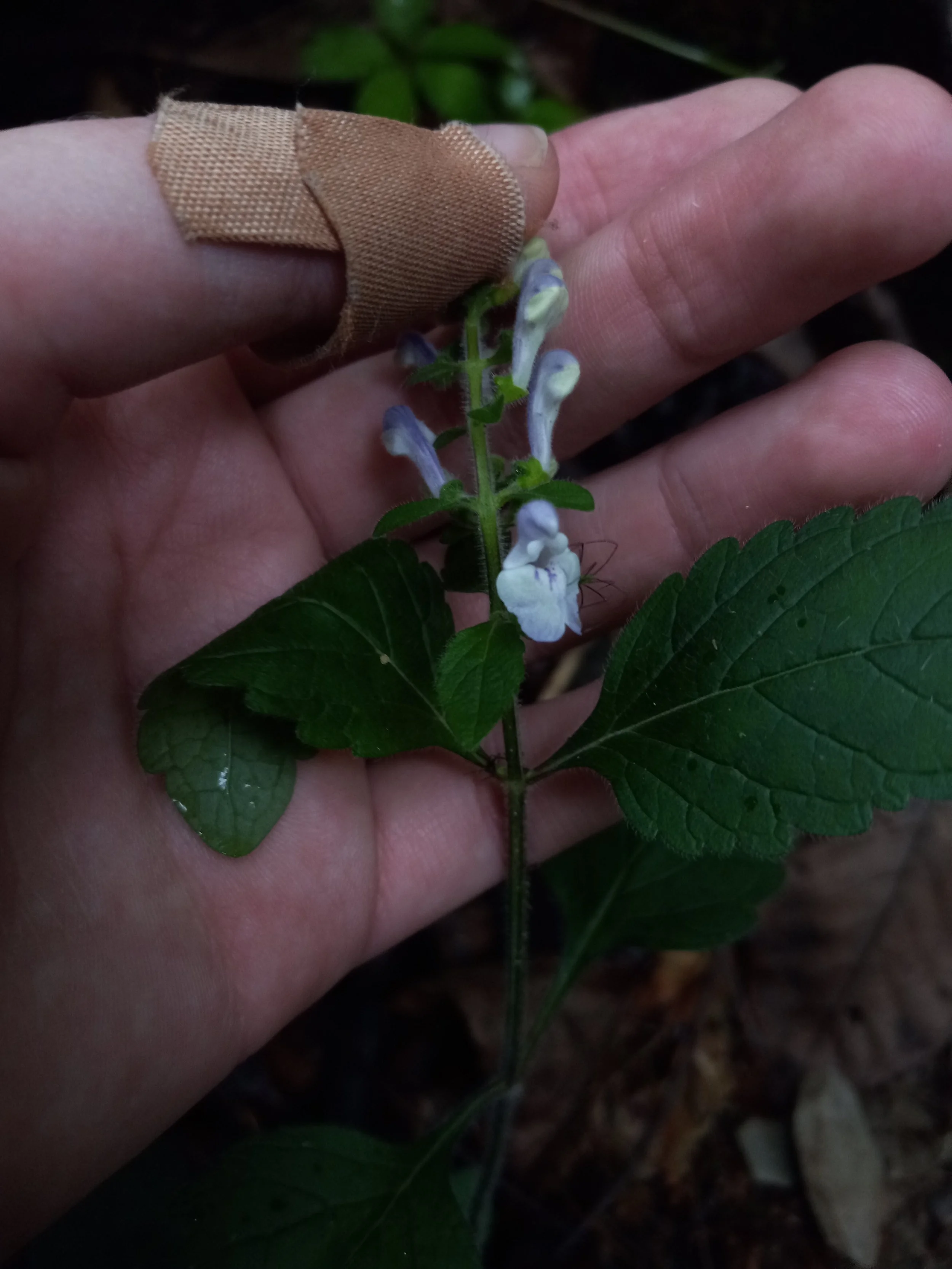
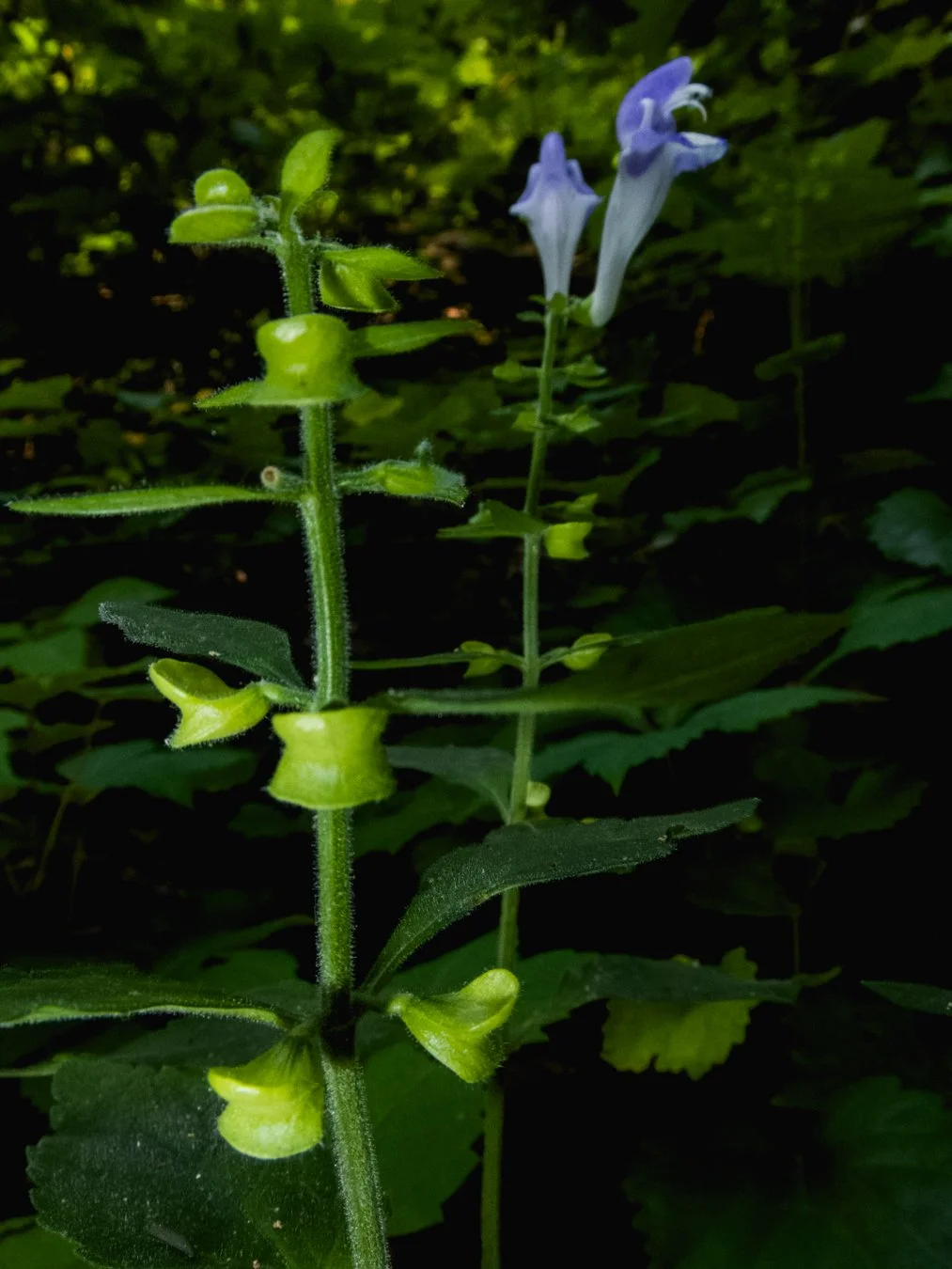
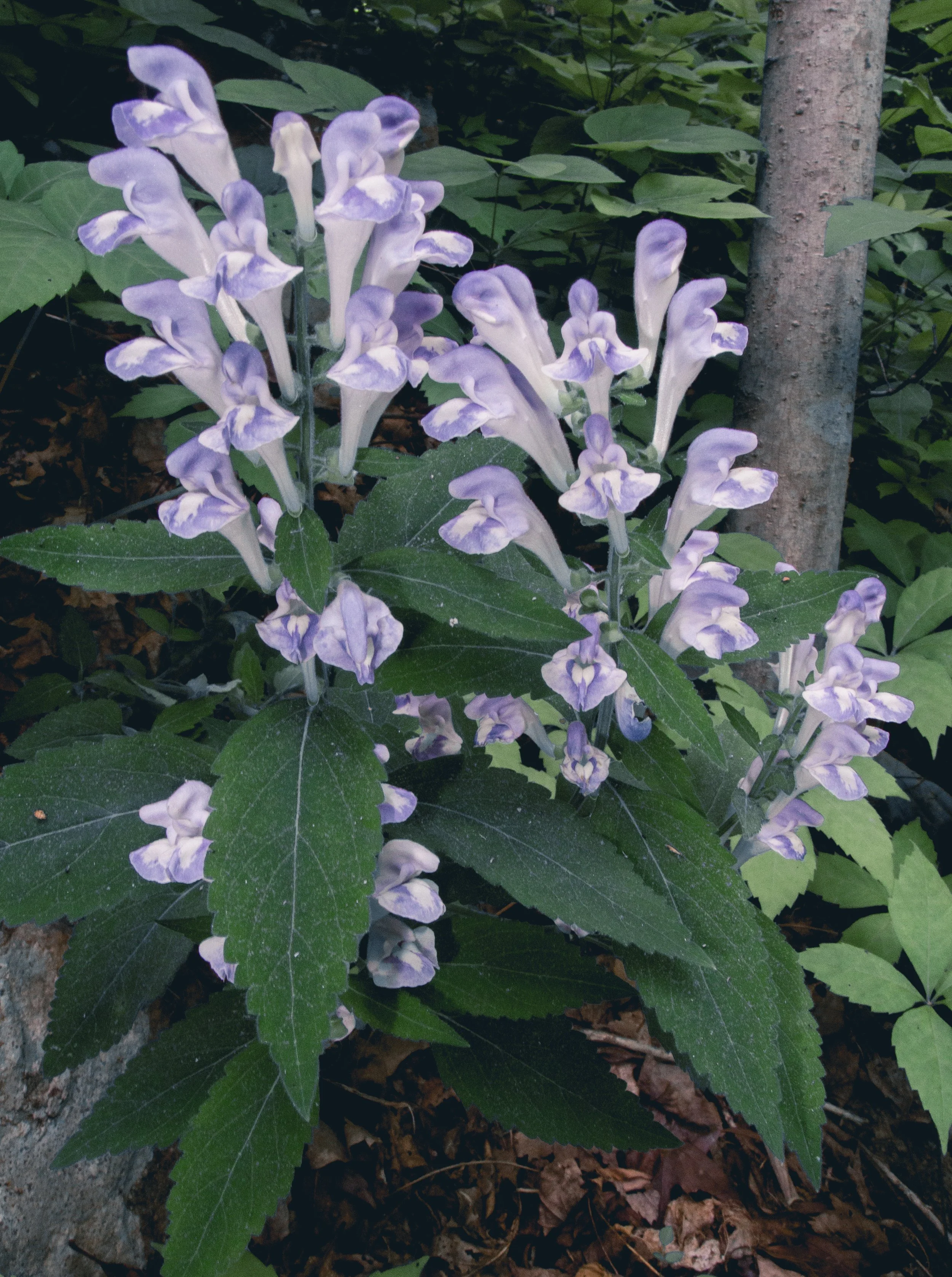
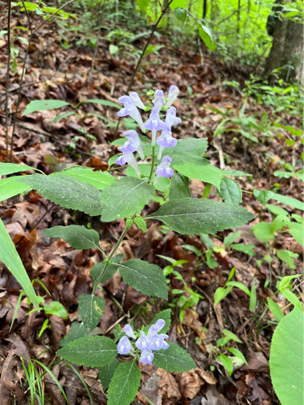
Close ups of a flowering skullcap, large flowered skullcap in full bloom is pictured in top right and bottom row. Photo credit: Dulce Brown, David Piñeros and Dr. Claire Wainwright.
Large-flowered skullcaps belong to the mint family and are in the genus Scutellaria. Skullcaps have opposite leaves, and most of the species in our area have toothed leaf margins. The flower's characteristic shape is the easiest way to identify a skullcap of any species, which also yields a unique seed head. Last May, we surveyed a handful of sites for large-flowered skullcap in the Gorge in partnership with TDEC, and the plant had surprisingly already gone to seed. This is early for this species, because it usually begins blooming around mid-May through June. Large-flowered skullcap can be found across southeast Tennessee and in northwestern Georgia. The Tennessee-Kentucky Plant Atlas notes that it has been found in Hamilton, Sequatchie, Marion, White, and Bledsoe counties in Tennessee. The Tennessee River Gorge Trust stewards property in both Marion and Hamilton counties.
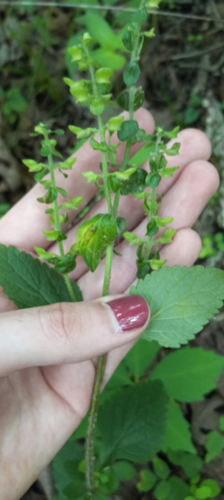
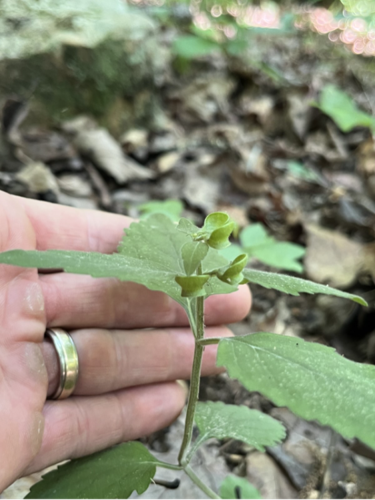
Scutellaria after flowering, the large flowered skullcap is pictured on the left. The seed heads have a distinctive shape, reminiscent of the of the flower segments. Photo credits: Dulce Brown and Austin Young.
It was a cool, but muggy morning when we set out with Dr. Claire Wainwright from the TDEC Division of Natural Areas. She is a botanist in the Tennessee Natural Heritage Program which uses Geographic Information Systems to monitor and map threatened or endangered species across the state. Some of this information is published and publicly available through TDEC’s Rare Species Data Viewer. Later in the week, we met David Piñeros, dubbed by Claire as the “Scutellaria whisperer.” Despite this impressive title, he spends most of his time as a conservation data manager for the Natural Heritage Program. Together with the TRGT team, we were able to find and mark hundreds of large-flowered skullcaps across several of our properties. One of our more surprising finds was the discovery of a few large-flowered skullcaps nearly buried in invasive ornamental bittersweet. Given bittersweet’s aggressive growth and tangled vines this is not a hospitable area for a small perennial like the large-flowered skullcap. We were encouraged to see these plants outside of their known occurrence in the Gorge meaning those individuals are brand new data points for the program.
There are many species of skullcaps in Tennessee, and for a novice plant surveyor, this means there are many lookalikes to encounter. Some other Scutellaria species include the heartleaf skullcap, hairy skullcap, mad dog skullcap, narrowleaf skullcap, and the falseteeth skullcap. The species that are most easily confused with the large-flowered skullcap are false teeth skullcap (Scutellaria pseudoserrata), heartleafed skullcap (Scutellaria ovata), and hairy skullcap (Scutellaria elliptica). Thankfully, the large-flowered skullcap has a distinctive, but perhaps unexpected, attribute. The top and underside of their deep dusky green leaves have a soft, almost velvety texture. There are slight variations in the leaf shapes, for example with heartleaf skullcap leaves being more heart-shaped and large-flowered skullcap leaves being more elongated with rounded bases. We rely mostly on leaf texture to quickly confirm our identification. Rubbing plant leaves between my fingers surprisingly became my favorite part of the “scavenger hunt” that is searching for large-flowers. Imagine scanning a rocky slope in mature hardwoods, spotting a slight clearing, and then looking for any soft-looking, deep green plant. You see something but are unsure of your guess, so you step closer, reaching for a small plant only a few inches tall. Ducking under a bramble, you confirm, a very soft leaf of this most elusive skullcap: the large-flowered skullcap.
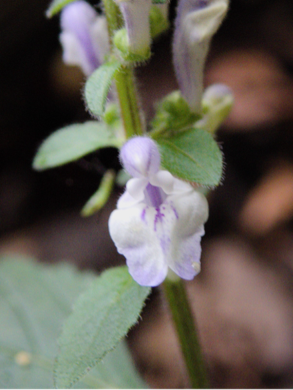
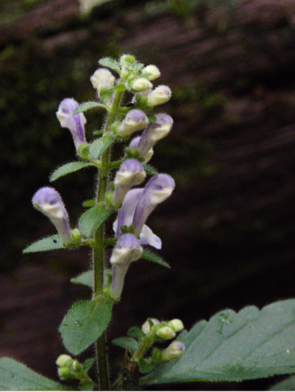
The hairy skullcap (Scutellaria elliptica) has prominent hairs all over the plant, including flowers. Although you might expect this species to also be soft, it feels almost like Velcro. Unlike other species of Scutellaria, the hairy skullcap has smaller corollas, and a stripe down the middle of the flower. Photo Credit: Austin Young.
But why are large-flowered skullcaps so hard to find? One challenge is that it lacks hyper-specific small-scale habitat preferences to help narrow down our search areas within the rocky forested slopes of the Gorge. Dr. Wainwright noted that she tends to find them in small clearings where a fallen tree allows light to reach the forest floor. However, she said that this is not always a reliable indicator, because the plant could just as easily be hidden in the shadows. The more notable challenge is reflected in the large-flowered skullcap’s conservation status. In 1986, federal biologists listed the plant as endangered under The Endangered Species Act. Since then, the population numbers have improved, and it was reclassified as federally threatened in 2002. Current and historical threats to this plant include development, quarrying, logging, and encroachment of invasive species. For a species to be considered truly stable enough to warrant delisting, it must have strong protected populations across its range. According to the Tennessee Natural Heritage Program, large-flowered skullcaps in Tennessee are ranked as an S4, or secure, category. This means that large-flowered skullcaps are considered “widespread, abundant, and apparently secure within the state, but with cause for long-term concern.” In Georgia, the state’s Natural Heritage Program ranks large-flowered skullcap as an S3 or vulnerable species. It’s important to recognize that legal delisting is foremost a complex scientific decision based on consistent long-term population monitoring data rather than opinions. The potential delisting of large-flower would be truly encouraging news! This would be a win for conservation for those in and beyond the Tennessee River Gorge.
If you believe you have discovered a large-flowered skullcap, congratulations on your observation skills! Make sure to note the coordinates of the location and take some close-up photos, but please don’t collect the plant. The Tennessee Natural Heritage Program welcomes the submission of your rare plant observation data. Please visit their home page and fill out the Excel form. This is a wonderful way to help conserve this fascinating species.